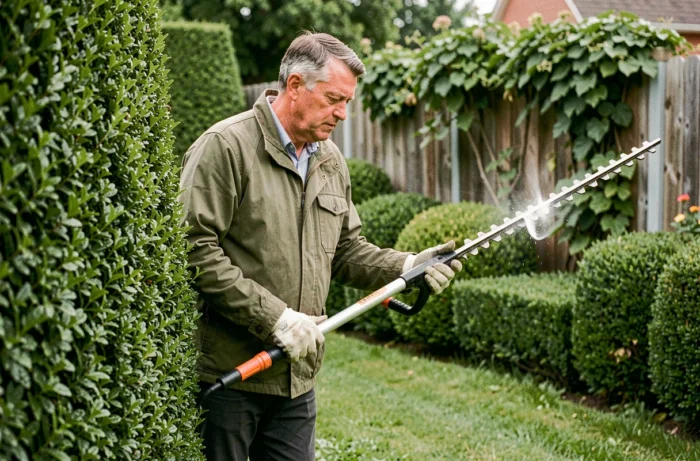
A hedge of thuja that exceeds three meters, a wobbly ladder on a sloping lawn, and a classic hedge trimmer held at arm’s length: we all know this situation. The telescopic hedge trimmer solves this specific problem by adding an adjustable pole between the motor and the blade. The next step is to choose the right model, as the differences in comfort and performance are much more pronounced than one might imagine between two references.
Center of gravity and tilt torque: what weight alone does not reveal
On a product sheet, you will find a weight in kilograms. You compare, you choose the lightest, and you think you’ve solved the ergonomics issue. In practice, when holding a pole over two meters inclined upwards, it is the position of the center of gravity that determines the fatigue felt in the arms and shoulders.
A model with the motor placed low and the blade at the end of the pole generates a higher tilt torque than a model where the mass is better distributed. The STIHL HLA 86, for example, features an optimized center of gravity and communicates distinct vibration values for each side of the machine. This type of technical data remains rare in buying guides, but it radically changes comfort during a trimming session of an hour or more.
Before purchasing, it is recommended to test the tool in-store by holding it with arms extended, pole deployed, for about thirty seconds. If fatigue sets in quickly, the tilt torque is too high, regardless of the displayed weight. Detailed comparisons can be found on taille-haie-telescopique.com that allow you to cross-reference these criteria before heading out.
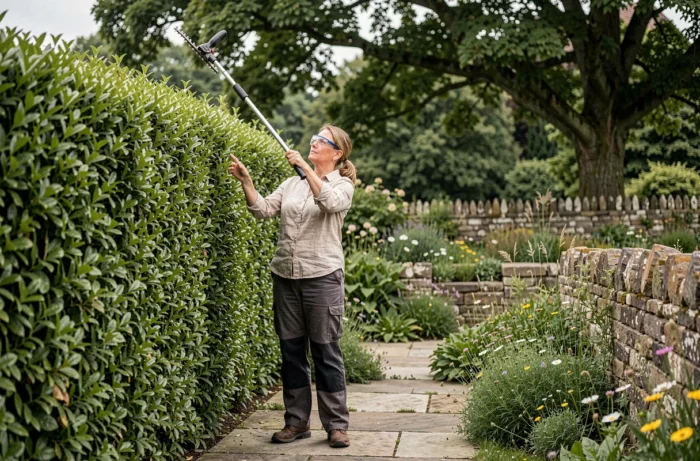
Battery, gas, or corded: noise as a selection criterion
The three types of motors cover different uses, and competitors are already discussing them extensively. Let’s get straight to the point that most overlook: the noise level legally conditions your trimming time slots.
The permitted time slots for powered tools depend on municipal or prefectural decrees. A nuisance can be considered excessive depending on its duration, repetition, and intensity, even during a normally permitted time frame. In a densely populated residential area, a gas model practically limits the times when you can work.
What it changes on a daily basis
- A battery-powered pole hedge trimmer allows you to trim early in the morning or late in the day without neighborly conflict, which is often the only available time slot during the week
- A gas model offers more power for thick branches but imposes reduced time slots and regular engine maintenance (oil change, spark plug, air filter)
- A corded electric model remains the lightest and least noisy, but the extension cord quickly becomes an obstacle when working at height with a telescopic pole
If the hedge to be trimmed is located at the property line next to the street, noise is just as important as power in choosing the model.
Blade and tooth spacing: adapting the tool to branch thickness
We often talk about blade length, but the spacing of the teeth determines the maximum diameter of the branches to be cut. A double-action blade with generous spacing is suitable for dense hedges of laurel or hornbeam, whose woody branches resist entry-level models.
A blade that is too short requires multiple passes, which prolongs the work and increases fatigue. Conversely, a very long blade on a telescopic pole makes the tool difficult to maneuver in corners. For a standard residential hedge, one seeks a compromise between reach and maneuverability.
Adjustable or fixed cutting head
On a telescopic hedge trimmer, the ability to orient the cutting head changes the game for trimming the top of a hedge. Without this function, you work with your arms raised and the pole nearly vertical, which causes fatigue in just a few minutes. A pivoting head allows for flat trimming without lifting the tool above shoulder height.
Feedback varies on this point depending on the brands: some angle locking systems loosen after a few seasons, while others hold up well over time. Checking the sturdiness of the pivot mechanism during the in-store trial helps avoid unpleasant surprises.
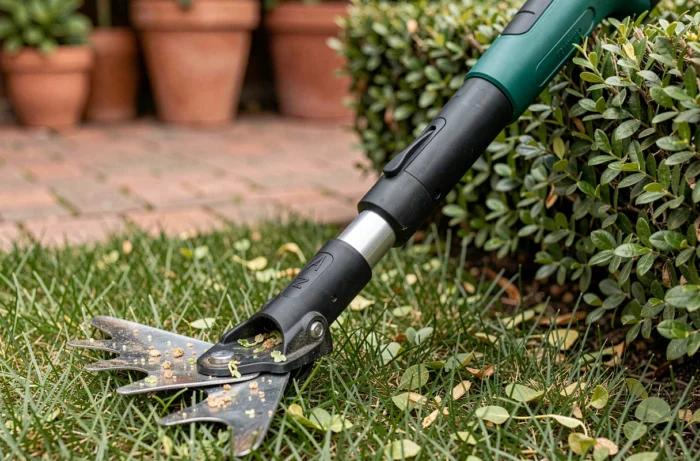
Trimming period and biodiversity protection
We don’t always think about it when choosing our tool, but the period of use is an integral part of hedge maintenance. The French Office for Biodiversity recommends avoiding trimming from early March to the end of August to limit disturbances during bird reproduction.
In practical terms, this means that the main trimming window is between September and February. Before each intervention, a quick inspection of the hedge is essential: if an occupied nest is visible, the work should be postponed.
This calendar also influences the choice of motorization. In autumn and winter, low temperatures can reduce the autonomy of lithium-ion batteries. A model with a battery that has sufficient capacity to cover the entire hedge in a single charge is preferable to a model that needs to be recharged midway in cold weather.
Blade maintenance: extending lifespan effortlessly
A poorly maintained telescopic hedge trimmer blade crushes branches instead of cutting them cleanly, which promotes fungal diseases in plants. After each session, a cleaning with a brush to remove dried sap, followed by a spray of lubricant, is enough to maintain a proper sharpness.
Sharpening is done once or twice per season with a flat file, following the original angle of the teeth. On double-action blade models, each tooth cuts in both directions, which doubles the number of surfaces to sharpen. This is a point to consider if you prefer minimal maintenance.
Ultimately, the choice of a telescopic hedge trimmer hinges on three concrete axes: the physical balance of the tool with the pole deployed, the noise compatibility with the trimming environment, and the tooth spacing suitable for the species present in the hedge. Testing before buying remains the best guarantee of not ending up with a tool that ends up at the back of the garage after two uses.