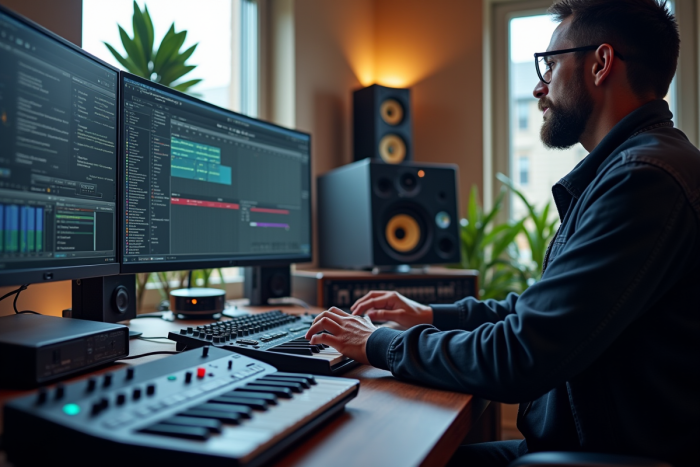
Ableton Live, FL Studio, and Pro Tools are leading the way in music production software around the world. However, their supremacy is increasingly being challenged. Young players like Soundation and BandLab are gaining momentum. Fueled by the wave of remote work, they are imposing new standards and gradually gaining more ground each month.
At a time when one must choose between several streaming platforms for the release of a track and select the right service to distribute their music, professionals are navigating an ecosystem that has become abundant. Usage is multiplying, forcing everyone to relentlessly monitor the latest applications, networks, or tools that could make a difference at every stage of the creative process.
2024 Overview of Essential Tools for Professional Music Production
Today, working in professional music production means composing with a range of tools that are both advanced and accessible. At the center of creation stands the music production software, also known as the DAW (Digital Audio Workstation). This digital toolbox encompasses recording, mixing, and mastering, while integrating an audio sequencer and extensive compatibility with a myriad of plugins and VSTs. A modular foundation capable of accommodating virtual effects, instruments, synthesizers, and all the refinements of modern sound editing.
To go further, musicians are betting on the addition of plugins: sophisticated effects, deep reverbs, delays, distortions, as well as virtual drums and pianos. The VST format has established itself as a reference, simplifying access to sound banks or cutting-edge processing tools. Professionals seek the balance between sound quality, flexibility, and intuitive interface. Some software powered by artificial intelligence is already automating mastering or suggesting new tracks, confirming the rapid transformation of the sector.
The balance remains delicate between heritage and modernity. Acoustic instruments retain their aura, even in the face of the triumph of Moog or Korg synthesizers and effects from Eventide or Universal Audio. In this ever-changing ecosystem, active monitoring of platforms is essential. Take a look at Audioz for an updated overview of music platforms, alternatives, and competitors, and discover how users are now influencing industry choices.
Which platforms really facilitate the creation, promotion, and distribution of your music today?
Producing music is no longer just a few hours spent in the studio. Digital platforms now play a role at every stage: creation, sharing, distribution. On the creation side, the rise of mobile and collaborative tools has changed the game. Here are the new habits adopted by those who compose everywhere, all the time:
- Apps dedicated to instant composition
- Solutions designed for recording on the go
- Sleek interfaces designed to capture an idea as soon as it appears
Social networks also play their part. With their specific modules, they give independent artists direct access to their audience, allowing them to share, interact, and build a loyal community.
For promotion, technology is infiltrating everywhere: automated playlists, detailed analysis of listening behaviors, viral propagation of excerpts. Recommendation algorithms now shape visibility. Everything hinges on the intelligent use of data. Professionals rely on these indicators to refine campaign targeting, plan releases, and anticipate new trends.
Distribution now relies on streaming, which has become the economic pillar of the industry. Specialized platforms provide tools to manage tracks, track results, and reach listeners around the world. Other models are emerging, such as blockchain or NFTs, which promise transparent rights management and the possibility to monetize creations directly. To accelerate the sharing of masters or remote collaboration, solutions like Dropbox, WeTransfer, or Google Drive are also becoming routine for professionals. Speed of execution, sound quality, control over distribution channels: this is the new triptych driving the music industry, more agile than ever.
Behind every track released today, there is this discreet ballet of tools, platforms, and innovations. Music production is constantly reinventing itself, driven by those who never accept stagnation.