
A French tablespoon does not contain the same amount of liquid as an American tablespoon. In Paris, 15 milliliters is sufficient; in New York, nearly 15.8 is needed. Some ingredients, like flour, vary drastically in weight depending on how they are measured, packed or aerated. Old cookbooks merrily alternate between grams, cups, and ounces, without reliable conversions.
A difference of a pinch or confusion between a fluid ounce and an ounce by weight can compromise a dish. Mastering equivalences and the right tools helps avoid mistakes and approximations.
Why the Precision of Measurements Changes Everything in Cooking
Weighing, dosing, measuring: behind these seemingly secondary actions lies the balance of a recipe. The precision of measurements directly affects the texture of a cake, the consistency of a sauce, the success of a dish. Too much liquid? The moistness evaporates. An excess of flour, and the dough becomes heavy. Throughout the pages of cookbooks or on specialized websites, the accuracy of conversions often separates failure from success.
Measurement units vary from one continent to another, from one book to another. Whenever it comes to juggling between grams, liters, cups, or ounces, one must be ready to convert. Flour, for example, takes up different space in a container depending on whether it is poured or packed. When the question of converting 150 g to milliliters arises, especially for dry ingredients, a vague estimate can throw off the entire balance of the dish.
The mastery of equivalences makes all the difference. In baking or for a slow-cooked dish, rigor in quantities ensures the result. A poorly anticipated conversion can make it difficult, sometimes impossible, to correct once the ingredients are mixed. International recipes require special attention in this area: even the slightest inaccuracy can lead to a loss of flavors.
To convert accurately, every action counts. Every ingredient, every unit deserves its rightful place. Cooking then transforms into a laboratory, where the accuracy of conversions, from liters to grams, from milliliters to ounces, paves the way for a new mastery of flavors.
Tools, Tips, and Charts to Easily Convert All Your Culinary Units
In the face of the diversity of units, rigor becomes a reflex. Between the metric system and Anglo-Saxon measurements, transforming quantities is not straightforward. However, concrete solutions exist and truly simplify the task.
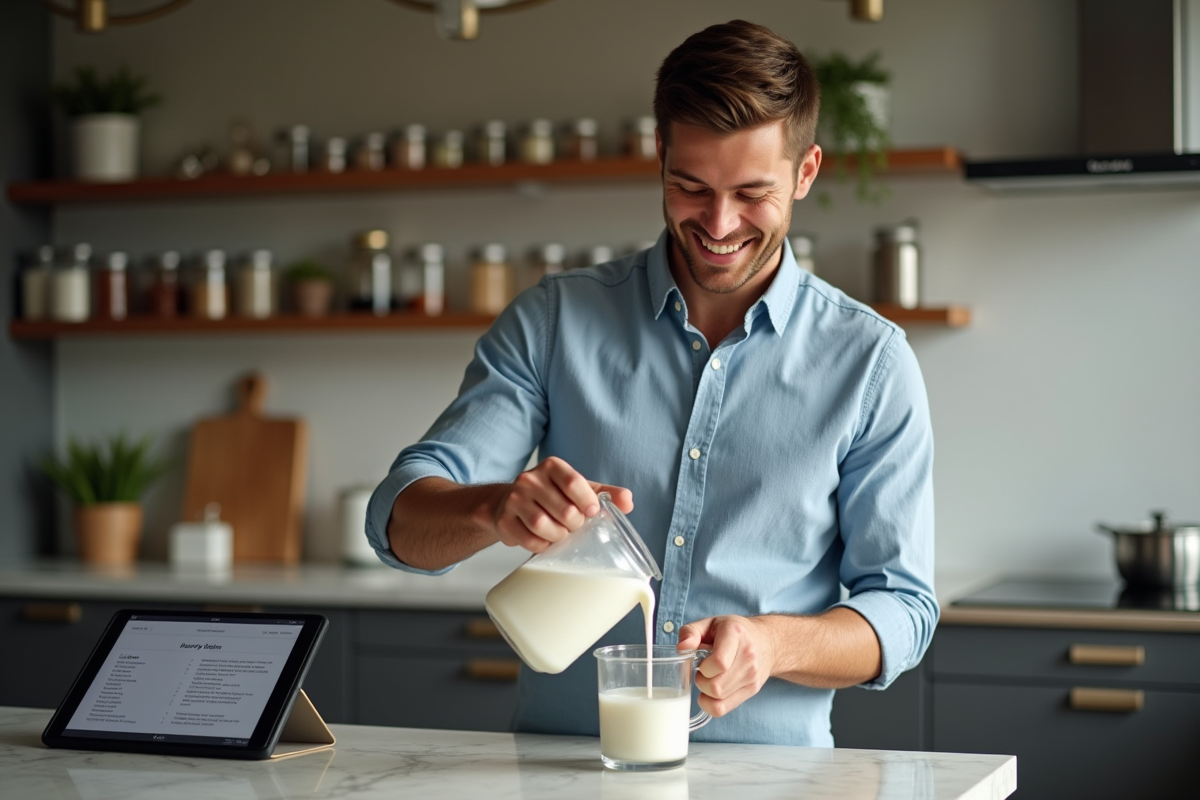
To find your way, measuring tools are valuable allies. A graduated measuring cup, a set of measuring spoons, or an electronic scale provide a reliable foundation for cooking with peace of mind. When conversion becomes complicated, conversion charts stuck to the fridge or in a drawer keep the information at hand, eliminating the need to pull out a calculator at every step.
Here are some basic equivalences to remember to limit discrepancies:
- 1 tablespoon = 15 milliliters
- 1 cup = 250 milliliters
- 1 centiliter = 10 milliliters
- 100 grams of sugar = 120 milliliters
Some habits make daily life easier: weighing dry ingredients to avoid any ambiguity, using graduations for liquids, memorizing key proportions. To convert milliliters to centiliters, simply divide by ten, a calculation that quickly becomes automatic with a bit of practice.
Conversion charts are invaluable for switching from one unit to another without hassle. Thanks to them, converting a cup to milliliters or adjusting a recipe according to the number of guests becomes a balancing act, where precision guides every action. You save time, gain confidence, and above all, achieve better results.
Mastering the conversion of measurements gives you the freedom to cook without borders, to try a foreign recipe or reinterpret a family classic without fearing the unexpected. One action after another, cooking opens up, precise and generous, to all desires.