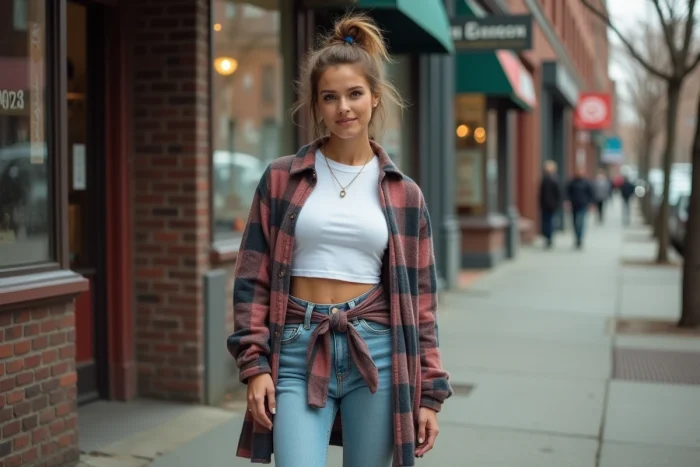
The clothing style of the 90s is based on a limited number of silhouettes and materials. Identifying these constants allows for the creation of a coherent wardrobe without randomly accumulating pieces. This article compares cuts, materials, and supply chains to determine which choices produce the most authentic results from the era while remaining wearable in everyday life.
90s Capsule Wardrobe: The Pieces That Structure the Wardrobe
The so-called “10-piece capsule” method, popularized by TikTok and Instagram creators specializing in “get ready with me – 90s” content, provides a useful framework. It is based on a core of interchangeable clothing that covers the main subcurrents of the decade: grunge, minimalism, and sporty streetwear.
| Piece | 90s Subcurrent | Portability 2025 |
|---|---|---|
| Light baggy jeans | Grunge, streetwear | Compatible with the current wide-leg trend |
| Cargo pants | Streetwear, hip-hop | Reintroduced by most mainstream brands |
| Oversized blazer | Minimalism | Worn in both office and casual looks |
| Thin strap tops | Minimalism, pop | Standard summer piece, very widespread |
| Flannel check shirt | Grunge | Available year-round in thrift stores |
| Sportswear logo t-shirt | Hip-hop, streetwear | Heritage reissues from Fila, Champion, Kappa |
| Satin slip dress | Minimalism | Adopted by contemporary evening wear |
This table shows that the majority of 90s pieces are already standardized in current fashion. The challenge lies not in availability, but in combination: wearing a single item is not enough to evoke the decade.
To delve deeper into the selection of these basics and understand how to combine them, the 90s clothing style on Eleganzia details associations by subcurrent.
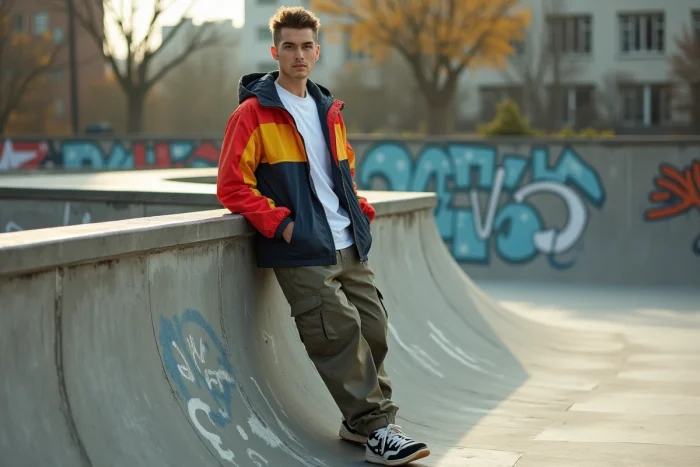
Heritage Lines or Vintage Thrift Stores: Where to Find Credible 90s Pieces
Two supply chains stand out for those wanting a 90s look without resorting to fast fashion. Their advantages and limitations differ significantly.
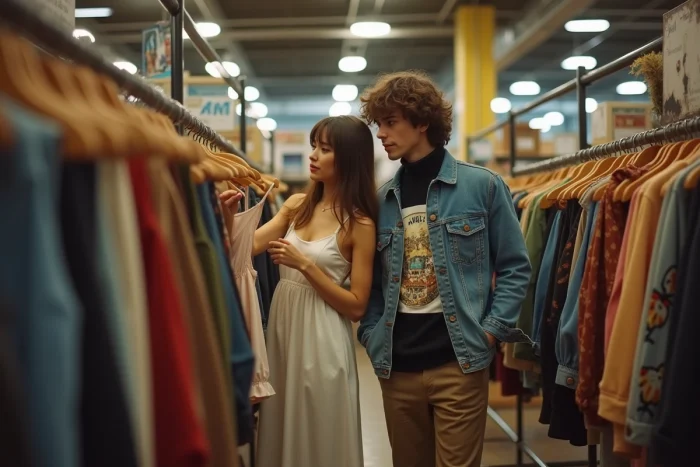
Second-Hand Platforms
Vinted, Vestiaire Collective, and Depop have developed since 2023 search functionalities by decade or targeted keywords (“Y2K”, “90s vintage”). Depop has notably created an editorial section “90s edit” identified in its Trend Report 2024.
The main advantage is authenticity: the pieces genuinely date back to the period. A vintage Levi’s 501 jean has a fading that reissues do not replicate exactly. However, sizes do not follow current standards, and the condition of fabrics varies significantly from seller to seller.
Heritage Collections from Period Brands
Fila (collection “Fila Heritage”, Fall-Winter 2023 lookbook), Champion (line “Champion Rochester Heritage”, Europe 2023 catalog), and Umbro (collection “Archive Research Project”, press release from January 19, 2023) reissue cuts and logos that are nearly identical to the originals. The materials are slightly updated, improving comfort without betraying the aesthetic.
The compromise is clear: heritage lines offer reliable cuts and standardized sizes, but the price remains higher than that of a second-hand piece in good condition.
- For a tight budget, second-hand platforms with decade filters provide access to original pieces at varying prices, often lower than reissues.
- For a coherent wardrobe without size uncertainty, heritage lines guarantee an updated fit and stock availability.
- Mixing the two sources (vintage pieces for denim and check shirts, heritage for logo sportswear) produces the most convincing result.
Oversized Cuts and Fitted Cuts: The Contrast That Defines the 90s Silhouette
90s fashion is not just about “everything oversized.” The decade is characterized by a play of contrast between loose pieces and fitted ones. It is this contrast that distinguishes it from current fashion, where oversized often dominates alone.
An oversized blazer worn over a thin strap top creates the visual tension characteristic of 90s minimalism. Baggy jeans paired with a fitted crop top replicate the streetwear balance of the time. Pairing two oversized pieces simultaneously produces a current look, not a 90s look.
This principle of contrast also applies to accessories. Baseball caps, crossbody fanny packs, and chokers serve as compact visual markers that anchor the silhouette in the decade. They add a recognizable touch without altering the structure of the outfit.
Materials and Colors: Grunge, Minimalism, and Sportswear Do Not Share the Same Palette
A common mistake is mixing color codes from incompatible subcurrents. Grunge relies on muted tones (red and black flannel, raw denim, khaki), minimalism on neutrals (black, white, beige, gray), and sporty streetwear on bright color blocks (contrasting logos, side stripes).
Choosing a subcurrent per outfit, rather than merging everything, makes the look readable. An effective 90s wardrobe contains pieces from two or three subcurrents, worn separately.
The materials follow the same logic. Thick denim and flannel belong to the grunge category. Satin and fine knit fall under minimalism. Nylon, mesh, and fleece define sportswear. Mixing satin with a flannel shirt produces a costume effect rather than a defined style.
Reproducing a 90s clothing style that holds up in everyday life is an exercise in selection, not accumulation. Identifying the subcurrent that matches one’s habits, choosing the right sources of supply, and respecting the principle of contrast between volumes: these three parameters matter more than the number of pieces purchased.