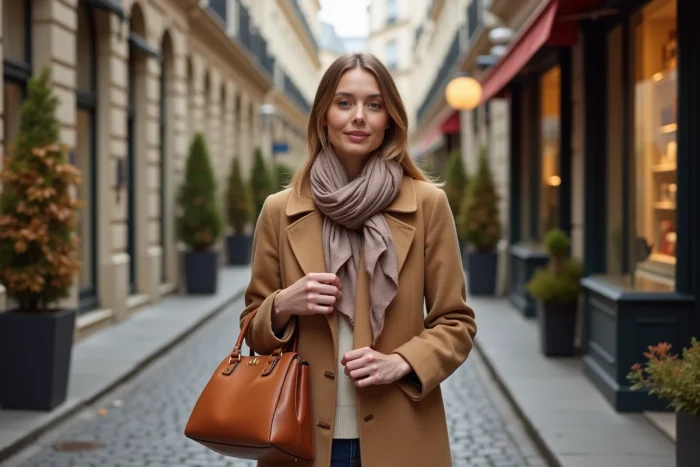
An ill-proportioned or default-chosen accessory can break a silhouette faster than a poorly cut garment. Elevating your style with trendy accessories requires mastering a few technical principles that most guides gloss over: volume ratios, material hierarchy, and color coherence. Here, we detail the concrete mechanisms that separate a composed look from a decorative stacking.
Volume Ratios and Accessory Distribution on the Silhouette
Each accessory occupies a visual zone. A wide-brimmed hat draws the eye to the upper third, an oversized bag weighs down the central third, and a pair of structured ankle boots anchors the lower third. One bulky accessory per silhouette third remains the most reliable rule to avoid overload.
Imbalance almost always arises from accumulation in the same area. Wearing XXL hoops, a voluminous knotted scarf, and a statement necklace simultaneously creates a mass effect around the face that flattens the features instead of framing them. We recommend distributing density: if the top is loaded (hat, large earrings), the rest of the silhouette benefits from remaining understated (narrow belt, compact bag).
This logic of volumes also works in reverse. A minimalist outfit (straight jeans, solid turtleneck) can support a statement bag or a wide belt without imbalance because the garment gives all visual space to the accessory. We observe that browsing accessories at Stylissima helps visualize these proportion plays on varied pieces, from discreet jewelry to structured bags.

Quiet Luxury and Logo-Free Accessories: A Shift in Piece Selection
The quiet luxury aesthetic, documented by the French Institute of Fashion since 2023, has redistributed the codes of accessorizing. Bags without monograms, minimalist gold or silver jewelry, and well-crafted belts without visible logos are gaining ground, particularly among 25-40 year-olds. The quality of the material replaces the logo as a style marker.
This shift has a direct consequence on how to compose a look. A quiet luxury accessory is identified by its cut, the grain of the leather, and the finish of the clasp, not by a recognizable pattern from ten meters away. This requires touching, inspecting, and comparing before buying, rather than relying on a brand emblem.
Concrete Criteria for Evaluating a Discreet Accessory
- The quality of stitching and the uniformity of the stitching on a bag or belt immediately reveal the craftsmanship quality, much more than a stamped logo
- The weight of a piece of jewelry in plated or solid metal is felt in hand: a bracelet that is too light often indicates a thin plating that will tarnish in a few months
- The flexibility of a silk or modal scarf is tested by its drape: a stiff fabric will never drape properly around the neck or on a bag
Focusing on these technical details allows for building a collection of durable accessories that transcend seasonal trends without becoming outdated.
Second-Hand and Rental of Trendy Accessories: Test Before Owning
Second-hand is no longer a plan B; it is a fully-fledged supply circuit. Vinted indicates in its 2024 impact report a significant increase in the “bags” and “costume jewelry” categories in transactions, driven by Generation Z. Vestiaire Collective and ByRotation confirm this trend in the rental segment, where one can borrow a designer bag or a pair of sunglasses for an event.
The stylistic interest is real. The rapid rotation of accessories through second-hand or rental allows testing bold pieces (a sculpted belt, a brightly colored bag) without a heavy financial commitment. If the accessory works in your wardrobe, you can then invest in a new equivalent of better quality.
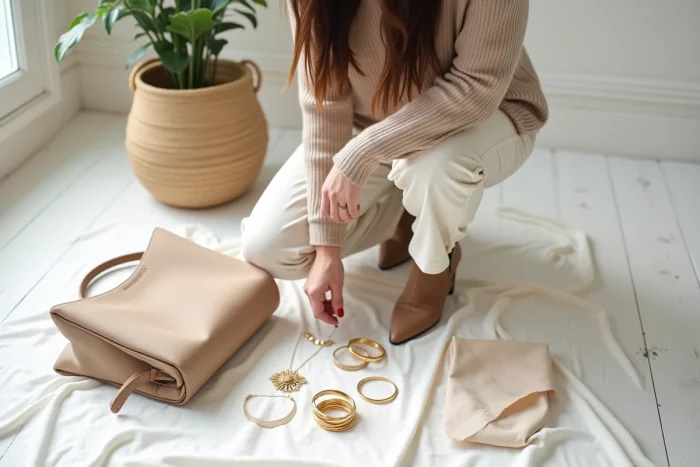
Precautions to Take in the Second-Hand Market
A second-hand leather bag deserves an inspection of the corners, closures, and interior. Signs of wear on the corners reveal the intensity of past use. For costume jewelry, check that the plating is not chipped at the clasps, the area of maximum friction.
A well-inspected second-hand accessory protects your style just as well as a new purchase. The budget saved can be redirected towards a durable piece of better quality.
Color Coherence and Material Hierarchy in an Accessorized Look
The rule of a maximum of three materials in the same look remains a reliable guideline. Leather, metal, and textile coexist naturally. Adding plastic, raffia, and vinyl in the same outfit creates visual noise that dilutes the impact of each piece.
In terms of colors, accessories serve as a chromatic link between the top and bottom. A bag that picks up the shade of a shoe unifies the silhouette. A scarf that borrows a secondary color from the dress creates a subtle visual echo. This principle works better than a total monochromatic look because it guides the eye without freezing it.
Mixing Metals and Jewelry Without a False Note
The mix of gold and silver works as long as a dominant is respected. Two gold pieces for one silver (or vice versa) establishes a readable hierarchy. An equal mix blurs the message and gives an impression of hesitation rather than a confident choice.
Jewelry in steel or oxidized brass offers an interesting third way: their neutral tone pairs well with both gold and silver, making them versatile in an accessory rotation.
Style is built through subtraction as much as addition. Removing a superfluous accessory before heading out remains the most underestimated gesture of accessorizing. A strong piece worn alone makes a bolder statement than a stack of trends.