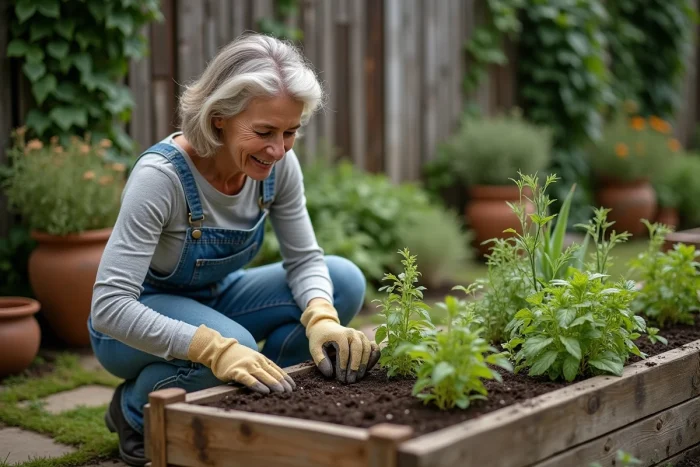
Designing a garden involves balancing conflicting constraints: the available soil, exposure, initial budget, and the maintenance time you are willing to dedicate each week. Most guides pile up decorative ideas without prioritizing these parameters. This article compares the main aspects of outdoor design to help you direct your choices where they will have a real impact.
Outdoor flooring materials: durability, maintenance, and climate adaptation
The choice of flooring affects both the visual outcome and the maintenance burden over the years. Rather than listing all options, let’s focus the comparison on four common materials for patios and garden paths.
| Material | Frost resistance | Annual maintenance | Permeability | Estimated lifespan |
|---|---|---|---|---|
| Concrete slab | Good | Low (pressure washing) | Low without drainage joints | Long |
| Composite wood | Good | Very low | Low | Medium to long |
| Stabilized gravel | Excellent | Moderate (weeding, raking) | Excellent | Variable (regular replenishment) |
| Natural stone | Variable depending on the stone | Low to moderate | Medium (possible open joints) | Very long |
The concrete slab remains the most common choice for garden paths. Its limited permeability poses an increasing problem in areas subjected to intense rainfall: water runs off instead of infiltrating, which accelerates the erosion of adjacent flower beds.
Stabilized gravel, on the other hand, allows water to pass through to the soil. It requires more regular maintenance but is better suited for gardens where stormwater management becomes a real concern. If you are looking for garden tips on Ta Maison Ton Jardin, you will find additional ideas for adapting the flooring to your terrain.
Natural stone offers the best longevity, but not all stones resist frost in the same way. A porous sandstone will crack after a few harsh winters, while granite will remain intact for decades.
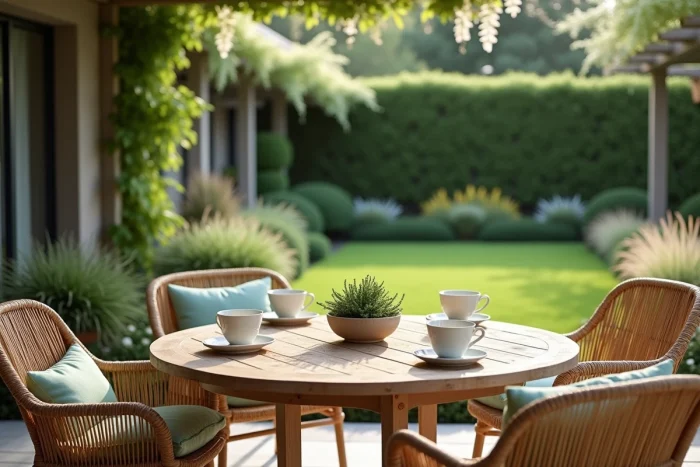
Garden zoning: creating functional rather than decorative spaces
Competitors often suggest “creating distinct zones” without explaining how to size them. The zoning of an outdoor space is based on a simple principle: each zone must serve a specific and recurring purpose.
A dining area used three times a week deserves an investment in durable furniture and a stable surface. A children’s play area, used daily for a few years, can make do with a durable lawn and a soft border.
Prioritizing zones according to usage frequency
Before marking out paths or installing borders, observe your actual movements in the garden for a week or two. The natural paths you take spontaneously reveal the circulation axes to formalize.
- The daily passage zone (access to the house, gate, trash area) requires a hard surface, easy to clean, usable in all weather
- The living area (patio, dining corner) needs a flat surface, sheltered from prevailing winds, ideally oriented to enjoy the sun in the evening
- The cultivation area (vegetable garden, flower beds, climbing plants) should be positioned according to the actual sunlight of the terrain, not according to the desired aesthetic plan
- The buffer zone (hedge, privacy screen, grassy strip) absorbs visual or noise nuisances and protects the living areas
This prioritization avoids the common mistake of designing a garden starting from aesthetics only to find later that the dining area is in a draft or that the vegetable garden receives only two hours of direct sunlight.
Plants and biodiversity: a design criterion, not an accessory
The choice of plants is rarely approached from the perspective of climate resilience in traditional design guides. Commercial content favors decorative varieties without mentioning their compatibility with increasing restrictions on pesticides.
Native plants require less watering and fewer treatments than imported horticultural varieties. They adapt to the local soil, resist regional pests better, and support pollinators.
Adapting plantings to actual exposure
A bed of climbing plants on a south-facing wall does not produce the same effect as one facing east. Sunlight conditions the choice of species, watering frequency, and growth rate.
Perennial flowers represent a more cost-effective investment in the long run than annuals: they return each year without replanting. The initial budget is higher, but maintenance costs decrease after the second season.
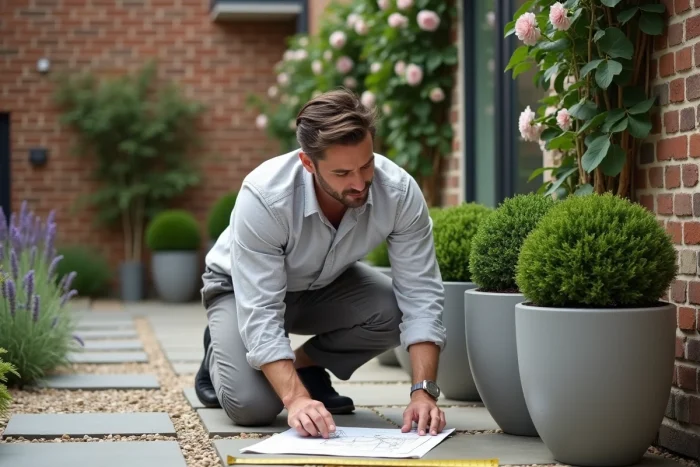
Elements that promote biodiversity (mixed hedges, areas of uncultivated soil, even modest water points) transform an outdoor space into an ecological corridor. This is not just an environmental issue: a garden that hosts natural allies (ladybugs, hoverflies, hedgehogs) requires fewer interventions against pests.
Garden design budget: where to focus spending
The classic temptation is to distribute the budget evenly across all items. Experience shows that it is better to invest heavily in the soil and structure, then adjust the plantings gradually.
A poorly laid or undersized patio surface will cost more to redo than to do correctly from the start. Plantings can grow season after season without losing coherence.
- Excavation and soil preparation represent the most structural part of the budget, the one that cannot be easily recovered later
- Outdoor furniture can be acquired gradually, starting with the most used pieces
- Decorative elements (ambient lighting, fountain, sculpture) come last, when the garden’s framework is already functioning
This prioritization logic also applies to small outdoor spaces. A balcony or a small courtyard of a few square meters benefits more from good flooring and well-chosen planters than from an accumulation of decorative accessories.
Designing a garden that lasts relies less on the quantity of ideas than on the quality of decisions between soil, exposure, and actual use. The choices made regarding materials and zoning determine long-term satisfaction much more than the aesthetic finishes added afterward.