
In France, a humanist wedding ceremony has no legal value. Only a marriage celebrated by a civil registrar at the town hall produces legal effects. A couple wishing to have a humanist ceremony must therefore go through the town hall first, then organize their personalized celebration as a complement. This dual approach structures the entire organization of a recognized humanist wedding in French territory.
Several European countries, such as Scotland or Norway, grant legal recognition to humanist ceremonies. France has not followed this path. Understanding this particularity helps avoid a common misunderstanding and allows for proper planning of each step, from the administrative file to the choice of officiant.
Humanist marriage and civil marriage in France: two distinct acts
The civil marriage remains the only union recognized by French law. It takes place at the town hall, in front of a civil registrar, with a reading of the articles of the Civil Code relating to the rights and duties of spouses. No exemptions exist for humanist, secular, or religious ceremonies: they have no legal significance.
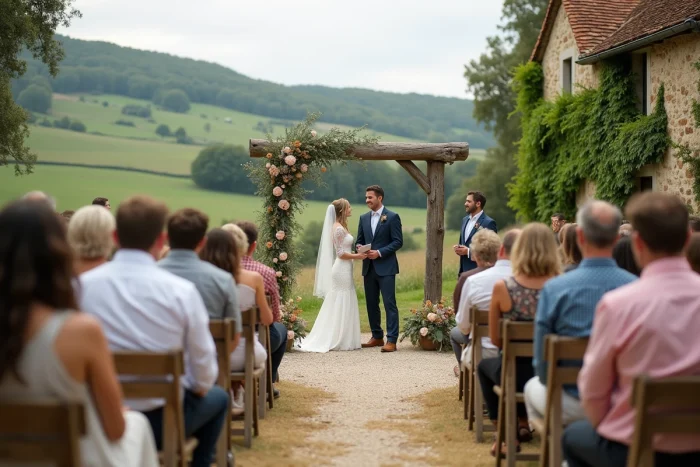
The humanist ceremony is defined as a non-religious celebration, centered on the couple’s values, their personal commitments, and a symbolic ritual. It usually takes place after the civil ceremony, at the reception venue or outdoors. Some couples choose to schedule it on the same day, while others postpone it by a few hours or days.
To delve deeper into the validity conditions and specific procedures, the humanist marriage on Espace Mariage details the points to check before getting started.
Administrative file at the town hall: documents and deadlines to respect
The civil marriage file is submitted to the town hall of the residence of one of the two future spouses. The required documents are framed by the Civil Code, and deadlines vary depending on the municipalities.
- Each future spouse provides a complete copy of their birth certificate dated less than three months ago (six months if the document is issued by a consulate)
- A valid identity document, proof of residence, and the list of witnesses (minimum two, maximum four) complete the file
- A certificate of publication of the banns is posted at the town hall for ten days before the scheduled date, which requires submitting the file several weeks in advance
- If one of the future spouses is of foreign nationality, a certificate of custom or marital capacity may be required by the town hall
The preliminary appointment with the civil registrar allows for checking the completeness of the file. Any delay in compiling the file postpones the publication of the banns, and thus the date of the ceremony.
Law reinforcing the principles of the Republic: what changes for humanist officiants
The law of August 24, 2021 reinforcing respect for the principles of the Republic has strengthened the obligations on 1901 law associations, including those that train or recommend officiants for secular and humanist ceremonies. This text is rarely mentioned in wedding guides, even though it has direct consequences.
Officiant associations must now sign a republican engagement contract to benefit from public subsidies. This contract imposes respect for freedom of conscience, equality among people, and public order. In case of non-compliance, subsidies can be withdrawn and accreditation questioned.
For a couple, this law does not prohibit anything. However, it ensures that the associative structures offering officiants respect a framework of neutrality. Checking that the chosen officiant is affiliated with an association that complies with these obligations is a relevant selection criterion, especially when the ceremony takes place in a public or semi-public location.
Choosing a humanist ceremony officiant: concrete criteria
The officiant of a humanist ceremony is not a regulated professional. Anyone can take on this role: a close friend, a family member, or an independent professional officiant. The choice depends on the desired degree of personalization and the couple’s comfort on the day of the celebration.
A professional officiant brings structure to the ceremony: they prepare a guiding thread, coordinate the contributions of loved ones, manage the rhythm, and handle the microphone. The preparation work with the couple usually begins several months before the date. The discussions focus on the couple’s story, shared values, and selected symbolic rituals.
Entrusting the ceremony to a loved one creates a different emotion but assumes that this person is willing to speak in public, structure a speech, and manage unforeseen events. A common compromise is to designate a loved one as the main speaker, accompanied by a professional officiant behind the scenes.

Points to check before signing with an officiant
- Request a preliminary, non-binding meeting to assess compatibility of tone and method
- Check if the officiant offers one or more preparation meetings, in person or via videoconference
- Clarify what is included in the service: writing the text, coordination on the day, site rehearsal
- Ensure that the officiant is available on the chosen date and location, as some only travel within a defined geographical area
Coordination between the town hall and humanist ceremony on the wedding day
Planning both ceremonies on the same day requires precise logistics. The town hall generally imposes a fixed time slot, often in the morning or early afternoon. The humanist ceremony is then scheduled, allowing sufficient time for guests to travel to the reception venue.
Allowing at least one hour between the end of the civil ceremony and the start of the humanist ceremony avoids any rush. This time also allows the photographer to take couple portraits before the light changes.
Some town halls accept slight personalization of the civil ceremony (reading a text by a witness, entrance music). This remains at the discretion of the civil registrar. Raising it in advance during the administrative appointment allows for knowing what is permitted in the concerned municipality.
A humanist wedding in France relies on this articulation between legal obligation and freedom of celebration. The town hall establishes the legal framework, while the humanist ceremony carries the personal dimension. Clearly separating the two in organization, planning, and budget remains the most reliable method for ensuring that each moment finds its place.