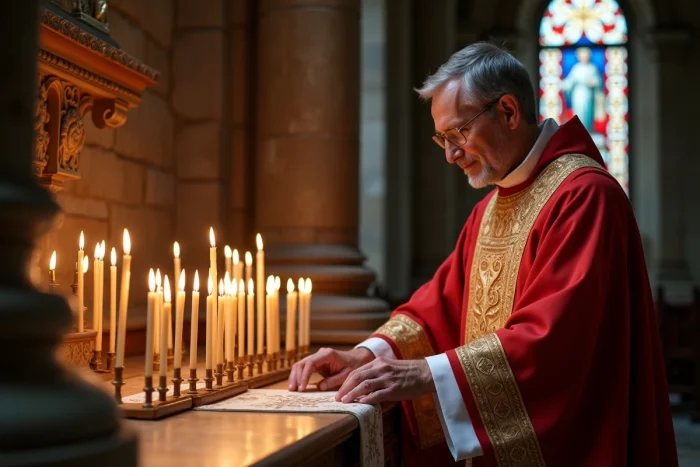
The medieval regulations surrounding candles on the altar were never set in stone: here, a single candle for the so-called “ordinary” mass, there, a requirement to respect an even or odd number depending on the solemnity of the day. The Council of Trent was careful not to make a definitive decision. The result: churches long oscillated between local traditions, implicit codes, and multiple symbols. Light, at times a sign of joy or a mark of mourning, displayed itself in shades, never fixed in a single meaning.
The Roman liturgy, in its current form, still bears the trace of these plural heritages. Today’s rites did not emerge from nowhere: they rely on the legacy of the Easter Vigil, on biblical figures, on a wealth of interpretations accumulated over the centuries. With each flame, a story. With each candle, a part of theology, custom, collective memory.
The Easter Vigil: a significant time of light and renewal in the Christian tradition
When the Easter Vigil arrives, Holy Week takes on a unique turn. The church plunges into darkness, then the Paschal candle emerges: lit from the new fire, it stands as a clear signal. The ceremony begins. The blessed flame carries the promise of renewal. The faithful follow the procession, literally moving toward the light, crossing in one step the symbolic boundary from the tomb to the brightness of the risen Christ.
This gesture, rooted in the long duration, gives a rare depth to the Easter mass. The chant of Lumen Christi resonates, reminding everyone that the light of Christ is not merely a decorative motif: it is meant to be an experience, a victory over darkness, an irruption of the divine into earthly life.
The transmission is not forgotten: during baptisms, each newcomer receives a candle, lit from the flame of the Paschal candle. This is not just a simple object: it is the concrete mark of a spiritual lineage, a light that circulates from hand to hand and transcends generations. The gesture echoes the Bible, fitting into a movement of living continuity.
For those who wish to understand the full significance of these traditions and explore the diversity of practices, the history of candles on the altar on Univers Mariage serves as a valuable resource. It reveals the demands of customs, the variety of forms, and the strength of symbols that traverse time.
What biblical symbols are revealed through the candles on the altar?
On the altar, the light of the candles draws its source from the early narratives of the book of Genesis. From the very beginning: “God created light.” Fire, from then on, signals the presence of the divine. Lighting a candle is not merely about pushing back the night: it is about rekindling the force of the first word, that emergence which opens the cycle of life and places the liturgy within a cosmic order.
The Jewish religion has also shaped this luminous symbolism. The menorah, a seven-branched candelabrum, burned continuously in the Temple of Jerusalem. This unalterable fire inspired the Roman liturgy, which plays on the number and arrangement of candles. On the altar, the flame bears witness to fidelity: it is the visible trace of memory, purification, and the presence of God among His people.
The transition to Christ further densifies the symbol. “I am the light of the world,” He states in the Gospel according to Saint John. Each candle placed on the altar during the mass recalls the victory of the risen one. Sometimes six candles, to remind of the six days of Creation; the seventh, reserved for the night of Easter, celebrates the irruption of the risen Christ into the heart of history.
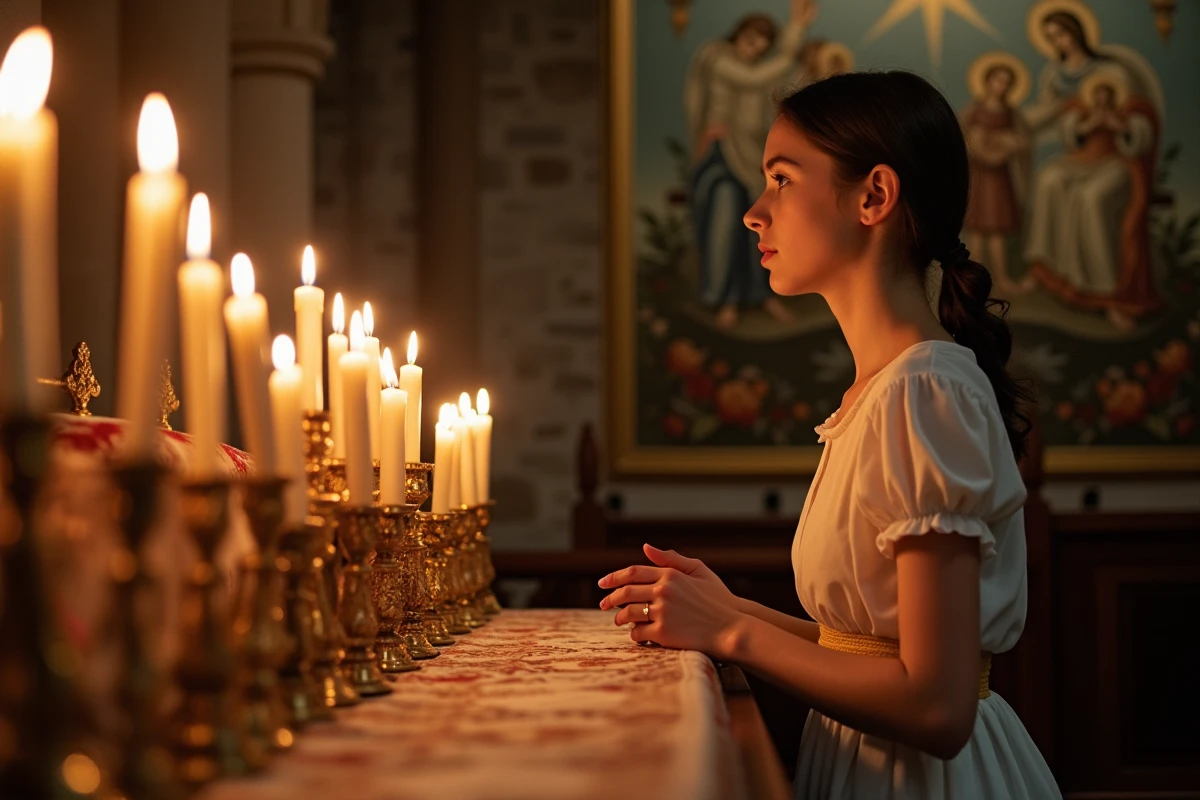
Illuminating the deep meaning: liturgical evolutions and spiritual significance of candles today
The presence of the candle on the altar is no longer confined to the liturgy of the past. Over time, its symbolic weight has expanded, adapting to societal changes and the variety of uses. The Paschal candle, still made of beeswax, retains its prominent place during the Easter Vigil mass. Its blessing opens the rite: the flame, passed from hand to hand, materializes the unity of the gathered group. The light circulates, reminding of life resuming, the community coming together.
In parishes, the range of candles has broadened. To give an overview of this diversity, here are some examples frequently encountered today:
- Traditional liturgical candles used during masses and processions
- Votive candles lit as offerings or for personal prayer
- Decorative candles, sometimes chosen for their aesthetics during special celebrations
- Advent wreaths with their four symbolic candles
- Candles for Candlemas, blessed in early February
- LED or electric candles, appearing in some churches for practical or safety reasons
Old candelabras sometimes stand alongside more modern devices, a sign of a desire to balance adaptation and fidelity to the luminous symbolism.
The significance of the lit candle extends beyond mere respect for tradition: it is rooted in the gestures of real life. The child who receives the light at baptism, the community that gathers around the Paschal candle, the discreet act of lighting a candle in the silence of a prayer: all these moments where the flame recalls the fragility, beauty, and persistence of the living. The candle, over the centuries, remains a support point, a silent marker – an invitation to inner vigilance and shared memory.