
You send a text message to someone, you receive the usual delivery receipt, and you conclude that everything is fine. However, this small signal can be misleading when the recipient has blocked your number. The behavior of the SMS delivery receipt varies depending on the phone, the operating system, and the protocol used to transmit the message.
SMS Blocking on Android and iPhone: What Happens on the Network Side
When someone blocks your number on their phone, the blocking occurs at the device level, not at the operator level. The mobile network does not know that you are blocked. It transports the SMS to the recipient’s cell tower and then transmits it to the phone.
This is when the operating system intervenes. On both Android and iPhone, the receiving phone filters the message before notifying. The SMS does arrive on the device, but it is silently redirected to a hidden folder or simply deleted, depending on the model and version of the system.
From the sender’s side, this mechanism poses a concrete problem. The network has successfully delivered the message. The recipient’s phone has technically received it. Knowing if an SMS is received when the number is blocked thus comes down to distinguishing between technical receipt and actual receipt by the person.
On most Android phones, the delivery receipt may still be displayed after a block because the network confirms delivery to the terminal. The message is “received” by the phone, even if the user will never see it in their main inbox.

Classic SMS Delivery Receipts and RCS Protocol: Two Distinct Logics
The confusion increases with the arrival of the RCS protocol, which is gradually replacing classic SMS on Android (via Google Messages) and recently on iPhone. Delivery receipts no longer function in the same way.
Classic SMS and Its Network Receipt
With a traditional SMS, the delivery receipt is managed by the operator’s network. The SMSC (Short Message Service Center) notes that the recipient’s terminal has successfully received the message, then sends a confirmation back to the sender. This mechanism does not account for software blocking on the phone.
The result: a SMS delivery receipt does not prove that the person has read your message. It only proves that the network has delivered the data to the phone.
RCS and Its Receipts on the Application Side
With RCS, the management of statuses (sent, delivered, read) goes through the messaging servers and the application itself, not through the classic SMS network. When a contact blocks you in RCS, the servers do not generate the same traces as for a blocked SMS at the phone level.
In practice, several operators no longer send a classic delivery receipt when the message is transmitted via RCS. A message sent to a number that has blocked you may then remain in the “sent” status without ever changing to “delivered.” This behavior is more revealing than with a classic SMS, but it remains ambiguous: a poor connection on the recipient’s side produces the same effect.
The specifications RCS Universal Profile 3.0 published by the GSMA now include the MLS (Messaging Layer Security) protocol. Delivery receipts become an encrypted function on the application side, no longer just a network confirmation. This evolution makes the reading of message statuses even more dependent on the application used by each correspondent.
Blocked SMS Folder: Where Filtered Messages End Up on Android
Some Android manufacturers and certain custom overlays store blocked SMS in a dedicated folder, accessible in the Messages app settings. The recipient can, if they wish, view messages received from blocked numbers.
Here’s what the main systems do:
- Google Messages on Android keeps blocked messages in a “Spam and Blocked” folder, manually accessible by the recipient
- On iPhone, filtered SMS from blocked contacts are redirected without notification, and most versions of iOS do not offer a visible folder to view them
- Samsung or Xiaomi overlays sometimes add their own filters, with varying behaviors depending on the software version
The sender has no way of knowing if the recipient has checked this folder. The delivery receipt, when it exists, does not distinguish between a message read in the main inbox and a message ignored in the blocked folder.
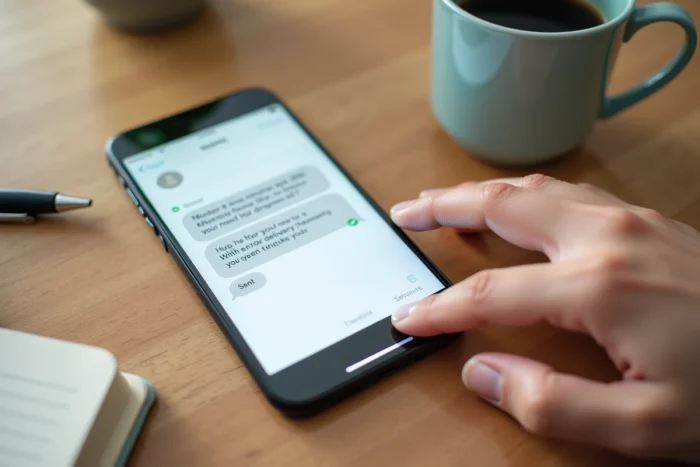
How to Interpret the Absence or Presence of a Delivery Receipt
Have you noticed that a message remains stuck in the “sent” status for several hours? Before concluding that your number is blocked, keep in mind that several causes produce the same symptom.
- The recipient’s phone is off or out of network: the receipt will only return upon reconnection
- The recipient has disabled delivery receipts in their messaging settings
- The message is transmitted via RCS and the server has not yet confirmed delivery
- The number is indeed blocked, and the system no longer generates confirmation
On the other hand, receiving a delivery receipt does not guarantee that your number is not blocked. With a classic SMS, the network can confirm delivery to the terminal even if the message ends up in a filtered folder.
The only relatively reliable clue concerns calls. If your calls consistently go to voicemail after just one ring (or none), while you get a normal ring when calling from a hidden number, blocking is likely. Combined with the prolonged absence of delivery receipts on your SMS, the evidence becomes stronger.
SMS, RCS, and Blocking: What Changes for the Sender
The gradual transition from SMS to RCS changes the game. With classic SMS, the delivery receipt gave a false impression of certainty. The message seemed “received,” while it could be filtered without anyone reading it.
With RCS, the absence of a “delivered” status is more telling, but still insufficient to conclude a block. No mobile messaging protocol explicitly indicates that a number has been blocked. This is a design choice: informing the sender of the block would compromise the recipient’s privacy.
The end-to-end encryption of RCS messages, recently deployed between iPhone and Android, reinforces this opacity. Read statuses are encrypted on the client side, making their interpretation even less transparent for the sender. A delivery receipt, whether present or absent, does not constitute proof of reading or blocking.